AI for Sustainability Transformations
01 Mission
The AI for Sustainability Transformations Project exists to explore how generative AI is reshaping the conditions for learning, decision-making and collective action in a time of profound ecological and societal instability. As these technologies rapidly influence how we think, connect and act, they raise urgent ethical questions and practical challenges for those working in sustainability transformations. Our mission is to ensure that engagement with AI does not drift from these commitments, but instead deepens and advances them.
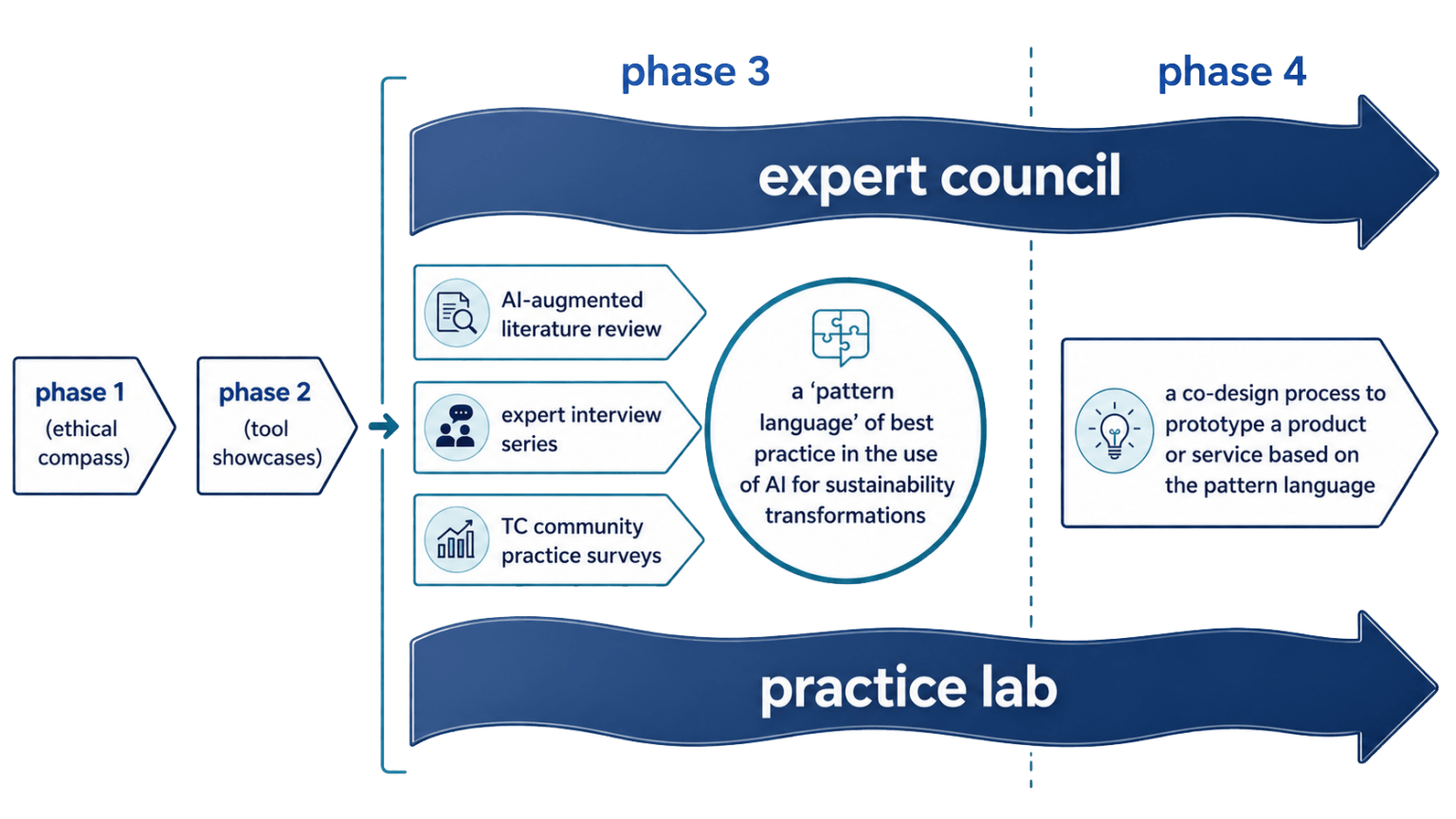
Building on earlier phases that established a shared ethical compass and mapped the landscape of emerging tools, the project is now focused on translating transformative values into everyday AI practice. In collaboration with Mútua Technologies, Metarelational Tech, and the Sustainable Impact Foundation, TC is advancing an ambitious agenda of inquiry and experimentation throughout 2026. Through transdisciplinary research, community engagement and creative exploration, we are developing a pattern language of effective and responsible AI use, grounded in practitioner experience and designed to generate practical wisdom for real-world application.
We will then be co-designing tools and services that bring this pattern language to life, creating tangible value for practitioners while fostering accountability and shared learning. By convening a vibrant Community of Practice and an external Expert Council in parallel with this work, the project aims to cultivate a living ecosystem of knowledge, experimentation, and stewardship. Together, we seek to shape how AI is used in sustainability transformations in ways that are ethical, grounded, and generative of meaningful change.
02 Practice Lab
Following the April kickoff sessions, the AI4ST Practice Lab is now continuing as an ongoing peer-learning and inquiry space for transformation practitioners exploring how AI is reshaping sustainability transformation work.
The Lab is designed as a cumulative journey rather than a set of stand-alone events. Each session builds on the last, helping participants develop shared language, practical insight, and collective wisdom around AI practice for sustainability transformations.
Participants are encouraged to join regularly, contribute examples from their own work, and help shape a broader understanding of effective, ethical, and context-sensitive AI use.
Practice Lab is evolving
We are currently pausing the recurring AI4ST Practice Lab series while we reflect on what has emerged so far and develop the next phase of the initiative. The Practice Lab has created a valuable space for practitioners to explore how AI is entering sustainability transformations work, where it may support practice, and where it raises deeper questions about judgment, trust, agency, and responsibility.
Rather than continuing the existing series in its current format, we are now shaping a more focused approach. Future opportunities for practitioner engagement will be organised around specific questions and emerging findings from the AI4ST inquiry, with an emphasis on deeper co-inquiry, meaningful participation, and direct contribution to what we are learning.
Stay tuned for updates as the next phase takes shape.
Session 6: Exploring and Organising Emerging Insights • Tuesday 1 September, 16:00 CEST
Participants will take ownership of one or two source texts from the shared knowledge base and come together in small pods to identify, discuss, and organise recurring themes, tensions, and examples.
This session will help the group begin making sense of what is emerging across the knowledge base, while connecting external insights back to participants’ own practices and questions.
Session 7: Surfacing and Refining Emerging Patterns • Tuesday 22 September, 16:00 CEST
This hands-on session will focus on documenting, refining, and connecting potential patterns of practice that may contribute to the broader AI4ST pattern language.
Participants will work together to identify what kinds of AI use appear effective, context-sensitive, ethically grounded, and relevant to sustainability transformation practice.
03 Previous Practice Lab Sessions
Session 1: Starting from Practice Kickoff Sessions · April 2026
The Practice Lab began with two kickoff sessions that invited participants to reflect on how AI is already showing up in sustainability transformations work.
Session 2: Mapping a Real Workflow · June 2026
In the second AI4ST Practice Lab session, Mapping a Real Workflow, a group of researchers and practitioners came together to examine how AI is entering real sustainability transformations work.
Session 3: Exploring AI Augmentation and Its Limits · June 2026
In the third AI4ST Practice Lab session, participants moved from theory into the messy, productive reality of everyday work.
Session 4: Reflection, Implementation and Ethical Consideration · July 2026
In the fourth AI4ST Practice Lab session, the one that wraps up its first full arc, the participants moved from mapping possibilities to weighing whether those possibilities are worth pursuing at all.
Session 5: When AI Enters the Room: Participation, Reflexivity, and What Gets Reconfigured · August 2026
In the fifth AI4ST Practice Lab session, participants asked what actually counts as transformative practice, and what happens to that practice when AI enters it.
04 Team

Rimaz Mohamed
AI Fellow
ALEX TVEIT
AI Fellow
05 Community Spotlight
Our AI Community Spotlight highlights transdisciplinary researchers and practitioners working at the intersection of AI, sustainability transformations, and complex real-world challenges.

Dr. Theresa Züger
Theresa Züger is an interdisciplinary researcher in the field of artificial intelligence (AI). She heads the AI & Society Lab at the Alexander von Humboldt Institute for Internet and Society. Her research focuses on the theory and practices of AI aiming to serve the public interest.

Silvia ferretti
Silva Ferretti is an independent consultant working across humanitarian, development, and peace sectors. She blends creativity, data visualization, and AI to leverage deep change—embracing complexity through curiosity, accountability, learning, and a culture of fresh thinking.

Scott Chaplowe
Scott Chaplowe is an international evaluation strategist advancing sustainable development through systems thinking, capacity development, and evidence use—bridging practice and policy across global initiatives, foundations, and crisis-affected settings. He is a learner and user of AI.
06 Past Workshops
Ghost in the Manuscript: Exploring Authorship and AI Using NotebookLM
On July 15th, 2025, our workshop explored how NotebookLM, Google’s AI “research assistant,” impacts authorship, agency, and knowledge creation. With guest critic Ollie Bream McIntosh, we examined the tension between AI enhancing research and diminishing our critical capacities. Participants highlighted the risk of AI tools like NotebookLM bypassing the creative “human struggle” in learning and stressed the need for a shared vocabulary in AI discourse. The workshop prompted us to reconsider our relationship with AI as a relational partner – one of many “nodes of intelligence in a reciprocal web of life” reshaping human knowledge.
Can AI Build Trust and Hold Space? A Workshop with Harmonica
On June 17th, 2025, we tested Harmonica — a generative AI tool for collaborative sensemaking. Participants explored its AI-assisted chat, surfaced ethical tensions, and reimagined AI as a sparring partner for collaboration. Our sounding board — Silva Ferretti, Scott Chaplowe, and Harmonica’s founder Artem Zhiganov — nudged the conversation further into the future of AI in collaboration.
Navigating AI With Purpose
On May 6th, 2025, we explored the ethical challenges of using AI in sustainability transformations, emphasizing the need for community-driven, locally tailored approaches. Engaging with our AI Ethics Manifesto, participants reflected on real-world ethical dilemmas and potential pathways to guide more responsible and equitable AI use in our collective transformation efforts.